How to Conduct Audience Analysis Online
Check out this styp-by-step guide to analyze your audience online

Mumbi Wanjiku
Contributing Writer @ Quorage
To conduct audience analysis, start by defining your ideal audience, researching your competitors, and using social media analytics to better understand your audience. Next, segment your audience into smaller groups based on shared characteristics, online behavior, interests, and needs.
Additionally, verify your research using social media polls, interviewing your existing customers, and joining and participating in the online communities your research showed your audience spends time in. The final step is to create audience personas to help you develop content and a marketing plan with a specific person in mind.
My friend Margaret, the owner of Zawadi Gift Hub, creates beautiful gift hampers and consistently shares high-quality content on social media. Despite all the effort she puts into her business, she’s struggling to grow her following and convert her content into sales. The problem isn’t the quality of her products or content: it could be that she hasn’t found the right audience yet.
If you’ve ever found yourself in a similar position, this guide is for you. I’ll walk you through practical steps to identify, research, and understand your ideal audience so you create content that reaches the people most likely to engage with your business and become loyal customers.
Let’s get to it.
How to conduct audience analysis: a step-by-step guide
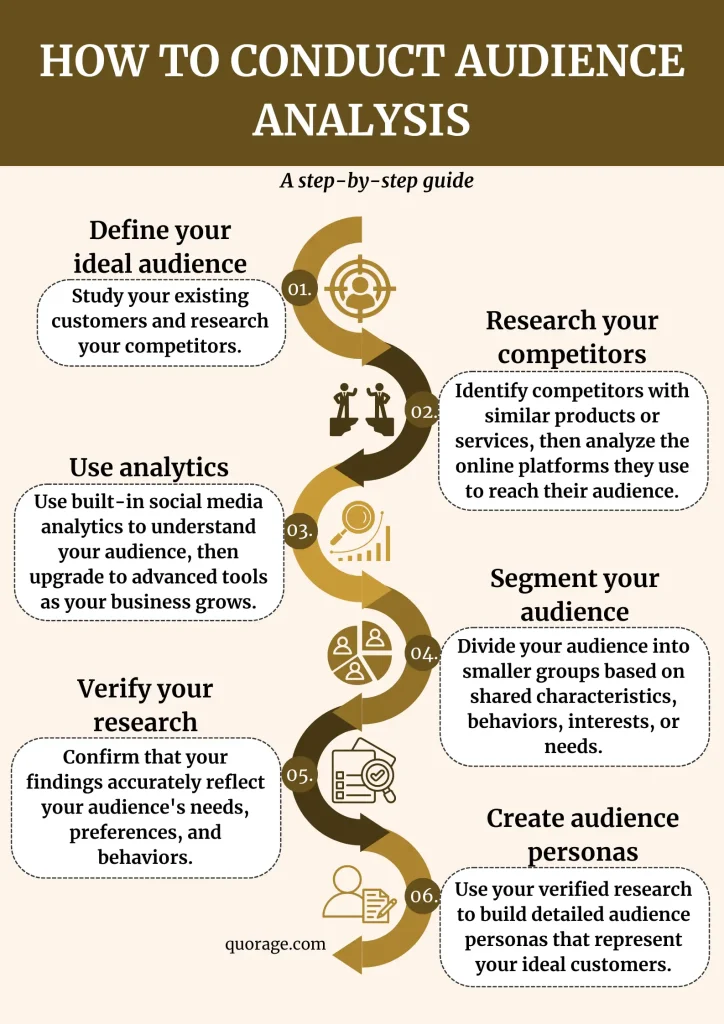
To conduct audience analysis, start by identifying your ideal customers, then research your competitors, segment your audience, verify your research, and finally create an audience persona.
Audience analysis is not a one-time task. Your customers’ preferences, challenges, and behaviors can change over time, so it’s important to revisit your research regularly. This way, you will keep your marketing relevant and ensure your messages continue to reflect the people you want to reach.
Step 1: Define your ideal audience
To define your ideal customers, start by studying your existing customers and researching your competitors. You should analyze your website and social media (if you have them), conduct surveys and interviews, and observe your audience’s online behavior. The more you understand who your audience is, what they care about, and where they spend their time online, the easier it becomes to create content that attracts the right people, builds trust, and increases sales.
Start by analyzing your most frequent customers. List down their characteristics. For instance, their occupations, age bracket, and shared interests. What’s their lifestyle, and what topics do they engage with?
For example, if you own a fitness brand, your customers may also be interested in healthy eating, home workouts, or wellness content. Understand their interests to create content that feels relevant to them.
In addition, you need to understand their buying behavior. Do they purchase during sales, around holidays, or after seeing product demonstrations? Recognizing these trends can help you plan promotions and publish content when your audience is most likely to take action.
To understand your most frequent customers and their characteristics, gather data using tools such as:
- Social media analytics for insights: If you already have social media platforms and have been posting content, social media analytics will show who engages, likes, and buys from you the most. You also get information such as your audience’s age, location, and the type of content they engage with most.
- Use Google Forms or social media polls to conduct surveys: ask your customers directly about which topics interest them, the kind of content they would like to see more of, and the challenges they face.
- Conduct brief face-to-face interviews with your walk-ins: Ask your walk-in customers open-ended questions about their needs, why they buy from you, the challenges they face, and what change they would like to see from you.
- Google Analytics to analyze your website, if you have one: Google Analytics will help you find out which social media platforms or websites most of your visitors come from. You also learn their age, gender, location, and how much time they spend on your site. This will give you insight into who your ideal customer is and which social media platforms they spend their time on.
- Social listening tools: Use social listening tools to track what your audience is saying online. Social listening tools will help you understand your audience’s pain points, track their language, identify where they hang out online, and monitor your competition.
Additionally, research your competitors to understand your ideal customers. Look for brands that are doing well and offering the same services as you on social media. Find out which communities they are most active in, and join and engage with these communities. Understand the characteristics of the audience in these platforms, as they are most likely your target audience.
Also look at who your competitors follow and who follows them back, and study the characteristics of these as well.
Also check what social media platforms they are posting most on, and which is getting the most engagement. Your competitors’ online behavior will give you insight into who your ideal customer is, what content they enjoy, and what their pain points are.
Once you’ve identified who you want to reach, the next step is finding out where these audiences spend their time online. Are they active on Instagram, Facebook, LinkedIn, or Reddit? Join these platforms and engage with them.
Once you’ve defined who is most likely to buy from you and which platforms they spend most of their time on, the next step is to understand your target audience’s online behavior. What time are they most active? What kind of content do they engage with? Whether it is behind-the-scenes videos, how-to videos, or aesthetic images. And finally, what questions do they frequently ask and what reviews do they leave? This will help you better understand their needs, interests, and purchasing decisions.
Step 2: Research your competitors
Identify a few competitors that sell similar products or services and target the same audience as your business, then review the online platforms they use to promote their businesses. Pay close attention to the types of content they post and which posts receive the most engagement. Also, observe the characteristics of the people who interact with their content to better understand their target audience. Finally, review the comment sections to identify recurring questions, concerns, and interests, as these offer valuable insights into your audience’s needs and preferences.
Once you have three to five competitors that target a similar audience to you, review their social media pages, blog posts, and other online platforms. Look at the kinds of posts they create and the formats they use most often. (Are they sharing behind-the-scenes videos, educational posts, product demonstrations, customer testimonials, or entertaining reels?).
The type of content that receives the most engagement will reveal how your audience prefers to consume information. For example, if short educational videos consistently attract more comments and shares than promotional posts, it suggests that the audience values learning before making a purchase.
Additionally, take a look at some of the people interacting with their content. While you won’t know everything about them, you will notice patterns in their profiles, such as their profession, location, interests, or the types of accounts they follow. These clues can help you build a clearer picture of the audience you’re trying to reach.
Next, look at which posts receive the most engagement. Sort through your competitors’ content and identify the posts with the most comments, shares, saves, or reactions. Then ask yourself why those posts performed well. Did they answer a common question? Tell a relatable story? Solve a problem? Announce a promotion? The goal is to understand what topics encourage people to participate in a conversation.
Also, look through the comment section. The comment section is often where an audience tells you exactly what they want to know. Look for recurring questions and concerns. For example, people may repeatedly ask about pricing, delivery times, product quality, or how a product works. These conversations can inspire blog topics, social media posts, and videos that address your audience’s needs before they even ask.
And finally, notice where your competitors receive the highest engagement. Some businesses may have a large following on Instagram but generate more meaningful conversations on Facebook or LinkedIn. This can help you decide where to focus your efforts, especially if you’re working with limited time or resources. Also observe what time your competitors post their content. If you notice they consistently post at similar times and receive strong engagement, test those posting times with your own audience and monitor your results. As your audience grows, use your own analytics to determine the best posting schedule for your business.
Remember, competitor research is about identifying patterns, not copying strategies. If several competitors receive positive engagement on similar topics or repeatedly answer the same customer questions, that is a strong indicator of what your audience wants to see. Use these insights to create original content that addresses your audience’s needs in your own voice.
Step 3: Use analytics
Start by using the built-in analytics tools available on the social media platforms where you have created accounts for your small business, and upgrade to paid tools as your business grows. Begin by studying your audience’s demographics to understand who you are attracting on these platforms, to get a clear picture of who your audience is. Next, look at your audience’s peak engagement times to determine when they are most likely to interact with your content. Finally, identify your top-performing posts and try to understand why they performed so well. Consider the questions they answered, the problems they solved, or the value they provided. This will give you valuable insight into the type of content your audience wants to see from you.
Analytics are data insights collected from your website, social media platforms, and other marketing channels. They help you understand how people interact with your business. They show you who your audience is, how they found you, what content they engage with the most, and what actions they take after engaging with your content.
If you’re new to analytics, start with the built-in insights available on your preferred platform before investing in paid tools. Once you understand how analytics work, explore more advanced analytics tools as your business grows.
Some of the most common analytics tools include Instagram Insights and Facebook Insights (available through Meta Business Suite). They show audience demographics, engagement, and follower activity. TikTok Analytics provides insights into video performance and audience behavior. While LinkedIn Analytics helps businesses understand their professional audience. YouTube Analytics tracks viewer demographics and watch time, and Google Analytics, which provides detailed information about your website visitors, where they come from, and how they interact with your site.
If you’re not sure how to use social media and Google Analytics, YouTube is a great place to learn. For example, if you want to understand how to use Instagram Insights, simply search for “How to use Instagram Insights for beginners” and watch a few tutorials.
To conduct audience analysis successfully using analytics, start by studying your visitors’ demographics on your preferred platforms. Find out how old they are. What gender visits your site the most? And where are most of your customers located? Your demographic insights will show you whether you have reached the audience you targeted or reveal an audience you hadn’t even considered.
For example, you may assume your products appeal to university students, only to discover that most of your followers are young professionals aged 25 to 34. This insight will influence the language you use, the products you promote, and the content you create.
Additionally, use your social media analytics to identify your audience’s peak engagement times. Most social media platforms provide analytics that show when your audience is most active. Use this information to plan and schedule your content. For example, if your analytics show that your audience is most active between 8:00 a.m. and 10:00 a.m. and again between 6:00 p.m. and 9:00 p.m., schedule your posts during these time periods to increase the likelihood that your audience will see and engage with them. You don’t have to be online waiting to publish your content. Use scheduling tools to save time and maintain consistency. Some of the best scheduling tools include SocialBee, Publer, and SocialPilot. Finally, review your social media analytics regularly, such as once a week, and adjust your content strategy based on the insights you gain about your audience’s behavior and preferences.
And finally, identify your top-performing content and engagement trends. Identify the posts that receive the most likes, comments, shares, saves, or views. Then look beyond the numbers and ask why they performed well. Did they answer a frequently asked question? Were they educational, entertaining, or inspirational? Did they feature a customer story or a behind-the-scenes video? Understanding what made a post successful will give you insight into who your clients are and what kind of content they want to see from you.
Also pay attention to how people interact with your content over time. A post with fewer likes but many comments may provide more valuable audience insights than a post with hundreds of likes and little conversation. Look for recurring themes in the comments, direct messages, and shares. These interactions often reveal your audience’s challenges, opinions, and the type of content they find most useful.
Remember that analytics should guide your decisions, not make them for you. Instead of focusing on a single post, review your performance over several weeks or months to identify consistent patterns. The more data you collect, the easier it becomes to understand your audience and create content that resonates with them.
Step 4: Segment your audience
After identifying your target audience, the next step is to segment them into smaller groups based on shared characteristics, behaviors, interests, or needs. Audience segmentation helps you better understand the different types of people within your audience so you can create more relevant content, marketing messages, and offers for each group. By focusing on the unique needs of each segment rather than using a one-size-fits-all approach, you can build stronger connections with your audience and improve the effectiveness of your marketing.
Audience segmentation is the process of dividing your broader audience into smaller groups that share similar characteristics. This allows you to create more relevant content and marketing messages for each group.
There are several ways to segment your audience, including:
- Demographics: Here you segment your audience by age, gender, income level, education, occupation, or location.
- Psychographics: Here you segment your audience based on their interests, hobbies, lifestyle choices, and beliefs.
- Behavioral: Here you focus on purchasing habits, engagement patterns, browsing behavior, or how often they interact with your content.
- Needs or challenges: Here, focus on the specific problems your audience is trying to solve. These needs might be physical, financial, or emotional.
For example, imagine you own an online gift business. Your research may reveal that your audience can be divided into three distinct groups:
- Young professionals looking for convenient corporate gifts.
- Couples searching for personalized anniversary or birthday gifts.
- Parents buying gifts for children’s birthdays or other special occasions.
Although all three groups buy gifts, their reasons for purchasing are different. A young professional may prioritize fast delivery and professional packaging, while a parent may be more concerned with affordability and finding gifts suitable for their child’s age. Understanding these differences helps you create content, promotions, and product recommendations that meet the needs of each group.
As you segment your audience, avoid creating too many groups. Start with two or three meaningful segments that represent the biggest differences in your audience’s needs. You can always refine or expand these segments as you collect more data.
The goal of audience segmentation is not simply to divide people into groups. It is to make your marketing more relevant to the people you want to reach. When your audience feels understood, they are more likely to engage with your content, trust your business, and eventually become loyal customers.
Step 5: Verify your research
Verifying your research helps confirm that the patterns you’ve identified reflect your audience’s real needs, preferences, and behaviors. Gather feedback through methods such as social media polls, online communities, customer interviews, and cross-source comparisons; you can make more confident marketing decisions based on reliable evidence.
Research verification helps you confirm that the patterns you’ve identified reflect your audience’s real opinions rather than your own assumptions. Even if the data points in one direction, it’s always worth checking your conclusions with the people you’re trying to reach.
Here are a few simple ways to do that:
1. Use social media polls
A quick way to collect feedback from your audience. You can use features like Instagram Stories, Facebook, LinkedIn, or X (formerly Twitter) polls to ask simple questions about their preferences. For example, ask questions like: Which type of content do you find most helpful? What is your biggest challenge when shopping for gifts? Would you rather watch a short video or read a blog article?
While polls won’t provide detailed explanations, they can help you identify trends and confirm whether your assumptions match your audience’s preferences.
2. Join online communities
Communities on platforms like Reddit and Facebook Groups can provide valuable insights into the questions, frustrations, and experiences people share.
Spend time observing discussions related to your industry before you begin promoting your business. Pay attention to recurring questions, the language people use, and the solutions they recommend. If community rules allow it, you can also ask open-ended questions to learn more about their experiences.
For example, if you sell personalized gifts, you might ask people what they consider when choosing a meaningful gift or what challenges they face when buying gifts online. Their responses can reveal concerns or expectations that may not appear in analytics alone.
3. Interview your customers
If you have loyal customers who regularly engage with your content or purchase from your business, consider asking if they’d be willing to participate in a short interview.
You don’t need a formal research process. Even a 5 to 10-minute conversation can help you understand why they chose your business, what almost stopped them from buying, and what they value most about your products or services.
Keep your questions open-ended so customers can explain their thoughts in their own words. Instead of asking, “Did you like our fast delivery?” ask, “What influenced your decision to buy from us?” This gives customers the opportunity to highlight what mattered most to them, even if it’s something you hadn’t considered.
As you collect feedback, look for themes that appear across different sources. If your analytics, competitor research, customer interviews, and online discussions all point to the same audience needs or challenges, you can be more confident that you’ve identified genuine insights.
The purpose of verification isn’t to prove yourself right. It’s to make sure your decisions are based on evidence. Taking this extra step helps you create audience personas and marketing messages that reflect the people you’re trying to reach, rather than the audience you assume you have.
Step 6: Create audience personas
After gathering and verifying your audience research, the next step is to create audience personas. An audience persona is a semi-fictional profile that represents a specific group within your target audience based on real data. By combining your audience’s demographics, goals, challenges, and online behavior into a single profile, you can better understand who you’re creating content for and develop marketing messages, products, and content that meet their needs.
An audience persona is a semi-fictional profile that represents a group of people within your target audience. Rather than describing each individual customer, a persona summarises the common characteristics, behaviors, goals, and challenges of a particular audience segment.
The purpose of a persona is to help you create content, products, and marketing messages with a specific person in mind.
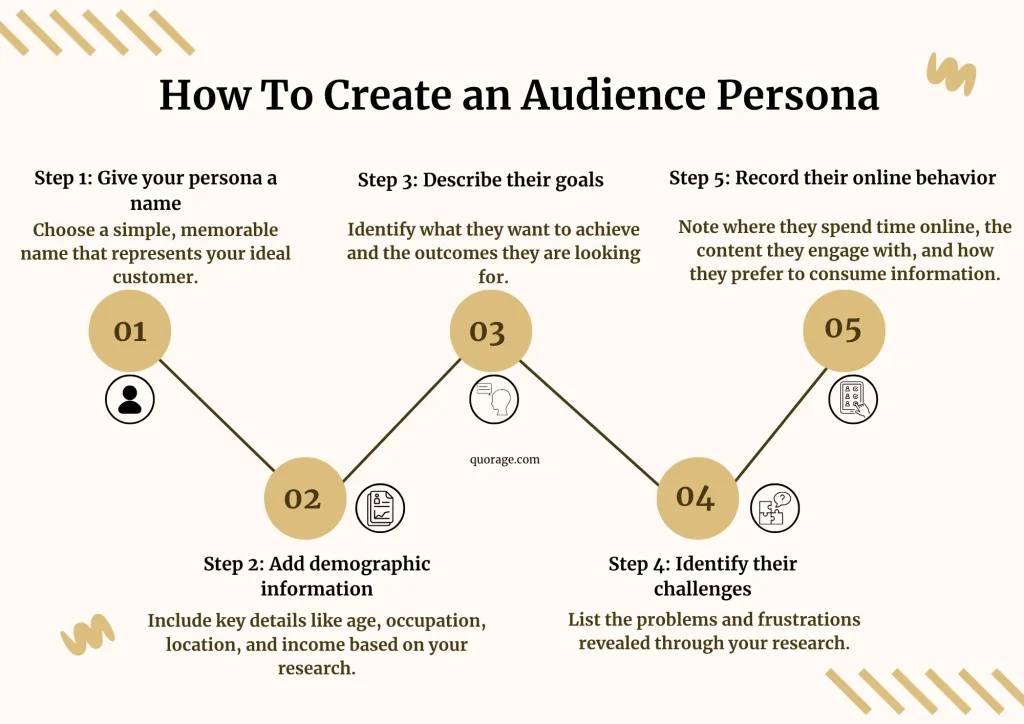
Here’s how to create an audience persona:
Step 1: Give your persona a name
Choose a simple name that makes the persona easy to identify, such as Corporate Claire or Busy Brian. The name helps you remember who you’re creating content for.
Step 2: Add demographic information
Include the basic details you’ve confirmed through your research, such as age range, occupation, location, and income level. Only include information that helps you make better marketing decisions.
Step 3: Describe their goals
What is your audience trying to achieve? Think about the outcome they’re looking for rather than the product they’re buying.
For example, someone buying a personalized gift may not simply want a gift box: they may want to make someone feel appreciated or celebrate an important milestone.
Step 4: Identify their challenges
List the problems, frustrations, or obstacles you’ve consistently found during your research. These should come from customer feedback, online discussions, reviews, or interviews rather than personal assumptions.
Step 5: Record their online behavior
Think about where they spend time online, the types of content they engage with, when they are most active, and how they prefer to consume information. This will help you decide where to market your business and what type of content to create.
An example of an audience persona created for an online gift business:
Name: Corporate Claire
Age: 28
Occupation: Human Resources Officer
Location: Nairobi
Goal: Find thoughtful corporate gifts that are easy to order and leave a positive impression on clients and employees.
Challenges: Has limited time to shop, wants reliable delivery, and needs gifts that can be personalized without a lengthy ordering process.
Online behavior: Uses LinkedIn for professional networking, follows small businesses on Instagram, and searches Google for corporate gifting ideas.
Content preferences: Short videos showcasing gift ideas, customer testimonials, gift guides, and behind-the-scenes packaging content.
As your business grows, revisit your personas regularly. Customer needs and online behavior can change over time, so updating your personas ensures your marketing continues to reflect the people you’re trying to reach.
To create audience personas, you can use templates to streamline your work. HubSpot MakeMyPersona is a good free template.
Beginner-friendly tools for social media target research
Use beginner-friendly tools, such as Reddit, Google Trends, Instagram Insights, Facebook Insights, Google Reviews, and competitor social media pages, to help you discover who your audience is, what they are interested in, the challenges they face, and how they behave online. By using a combination of these research tools to identify patterns across different sources, you can gain more accurate audience insights and create content and marketing strategies that better meet your audience’s needs.
You don’t need expensive software to understand your audience. Many of the best audience insights come from free tools that show you what people are searching for, talking about, and engaging with online.
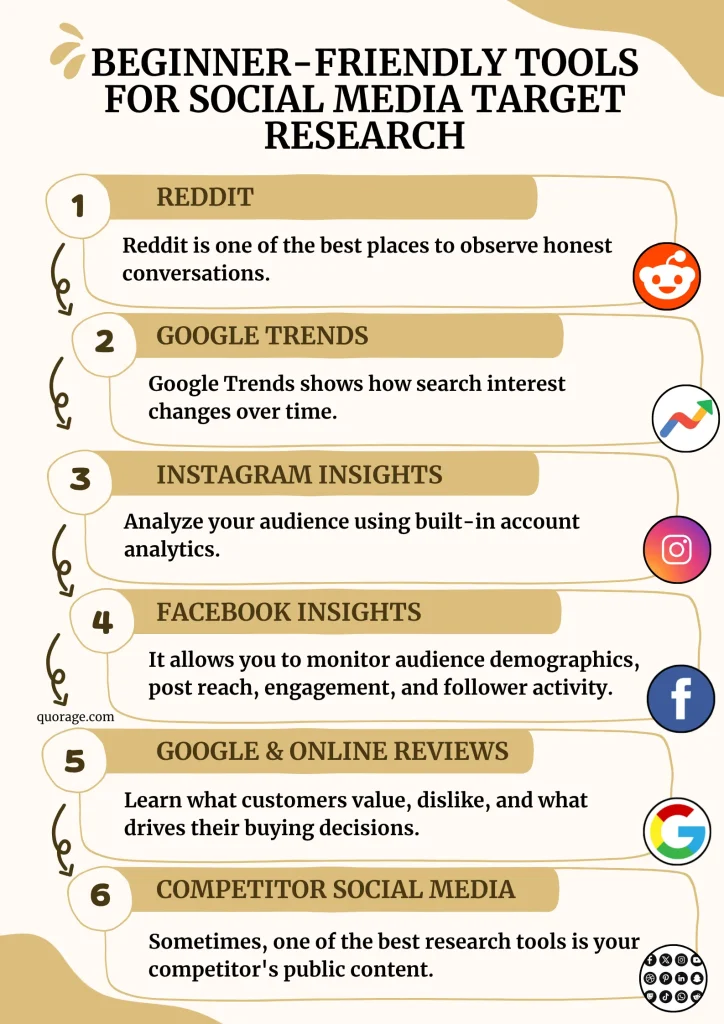
Here are a few beginner-friendly tools to get you started.
Reddit is one of the best places to observe honest conversations. People often use Reddit to ask questions, seek advice, and share personal experiences.
Search for communities related to your industry and pay attention to the discussions. Notice the questions people ask repeatedly, the challenges they mention, and the language they use to describe their experiences. These conversations can help you identify content ideas, frequently asked questions, and common pain points.
Google Trends
Google Trends shows how search interest changes over time. It can help you identify whether a topic is becoming more popular, compare different search terms, and discover seasonal trends.
For example, if you own an online gift business, you can compare search terms such as “birthday gift ideas” and “personalized gifts” to see which attracts more interest at different times of the year. This information can help you plan your content and marketing campaigns around topics people are actively searching for.
Instagram Insights
If you have a professional or creator account, Instagram provides built-in analytics that help you understand your audience.
Use Instagram Insights to see when your followers are most active, which posts receive the highest engagement, and basic audience information such as age range, gender, and location. Over time, these insights can help you identify the content formats and posting times that resonate most with your audience.
Facebook Insights
It allows you to monitor audience demographics, post reach, engagement, and follower activity.
Review your top-performing posts to understand what encourages your audience to comment, share, or react. You can then use these patterns to guide your future content strategy.
Google Reviews and online reviews
Customer reviews can reveal what people value, what frustrates them, and what influences their purchasing decisions.
Read reviews for your own business as well as your competitors’. Instead of focusing only on star ratings, pay attention to the reasons behind positive and negative feedback. If customers repeatedly praise fast delivery or complain about unclear product information, those patterns can help you improve both your marketing and customer experience.
Competitor social media pages
Sometimes, one of the best research tools is your competitor’s public content.
Review the posts they publish, the comments they receive, and the conversations taking place within their community. Look for recurring questions, highly engaged content, and topics that generate meaningful discussions. Remember, the goal isn’t to copy their strategy but to better understand the audience you both serve.
These tools become even more valuable when you use them together. For example, you might notice a common question on Reddit, confirm growing interest using Google Trends, and then use Instagram Insights to see whether your audience engages with content that answers that question. Look for patterns across multiple sources to have a more complete understanding of your audience.
How to use collected data correctly
By identifying patterns across multiple sources and applying what you learn, you can create more relevant content, improve your messaging, refine your products or services, and make informed decisions based on your audience’s needs. Regularly reviewing your audience research will also help you adapt to changing customer behaviors and keep your marketing strategy effective over time.
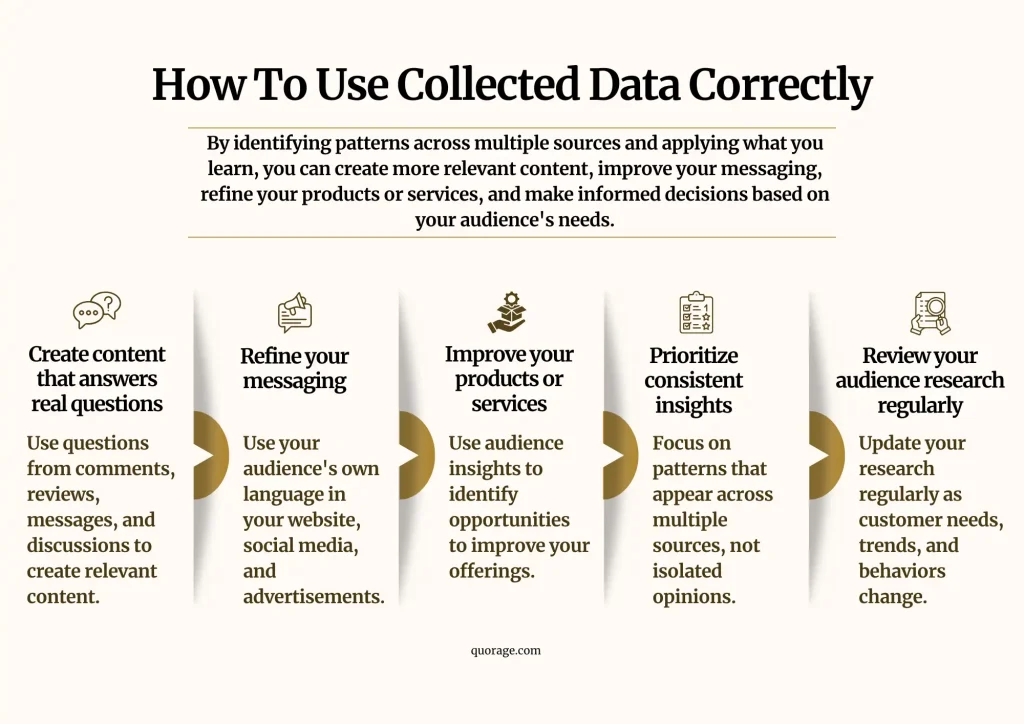
Rather than looking at each insight on its own, look for patterns across multiple sources. For example, if customers frequently ask the same question, competitors regularly create content on that topic, and you notice similar discussions on Reddit, there’s a strong chance it’s an issue your audience genuinely cares about. These repeated patterns are often more reliable than a single comment or one viral post.
Once you’ve identified these patterns, use them to guide your decisions.
1. Create content that answers real questions
Your audience is constantly telling you what they want to know through comments, reviews, direct messages, and online discussions. Instead of guessing what to post next, create content that addresses those questions.
For example, if people regularly ask how to choose the right personalized gift, you could create a gift guide, a short explainer video, or a blog post answering that question. This approach positions your business as a helpful resource while addressing a genuine audience need.
2. Refine your messaging
The words your audience uses matter. Pay attention to the language they use when describing their challenges, goals, or frustrations, and reflect that language in your website copy, social media captions, and advertisements.
Using familiar language makes your messaging feel more relevant because you’re communicating in terms your audience already understands.
3. Improve your products or services
Audience research isn’t just useful for marketing; it can also highlight opportunities to improve your business.
If customers repeatedly mention that they would like more color options, faster delivery, or clearer product descriptions, treat this as valuable feedback rather than criticism. Small improvements based on customer insights can have a meaningful impact on the overall customer experience.
4. Prioritize the insights that appear consistently
Before making significant changes, ask yourself whether the same insight appears across multiple sources. Not every comment or suggestion requires immediate action. Some opinions reflect individual preferences rather than the needs of your broader audience.
If similar feedback comes from customer reviews, social media comments, interviews, and online communities, it’s more likely to reflect a genuine audience need.
5. Review your audience research regularly
Audience behavior changes over time. New trends emerge, customer needs evolve, and the platforms people use may shift. That’s why audience analysis shouldn’t be treated as a one-time activity.
Set aside time every few weeks to review your analytics, customer feedback, and online conversations. Regularly updating your research will help ensure your content and marketing strategy continue to reflect your audience’s current interests and challenges.
The goal of audience analysis isn’t to collect as much data as possible. It’s to understand your audience well enough to make confident decisions. When you base your marketing on real insights instead of assumptions, you’re more likely to create content that resonates with the people you want to reach.
Common mistakes while doing audience analysis and how to avoid them
Some common mistakes include: relying on a single source of information, creating audience personas too early, collecting data without taking action, and treating audience analysis as a one-time task.
The most common mistakes people make while researching their audience include:
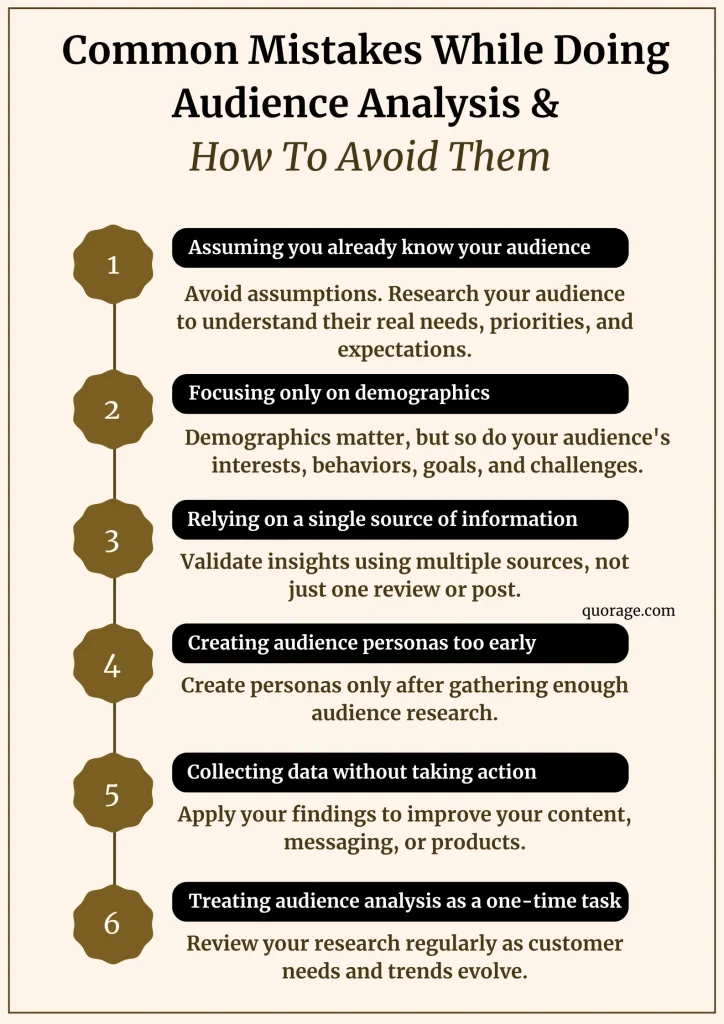
Assuming you already know your audience
One of the biggest mistakes beginners make is relying on assumptions instead of research. It’s easy to believe you know what your audience wants, especially if you’re passionate about your product or service. However, your audience may have different priorities, concerns, or expectations than you initially thought.
Always test your assumptions using customer feedback, social media conversations, competitor research, and analytics before making marketing decisions.
Focusing only on demographics
Knowing your audience’s age, gender, or location is useful. However, demographics alone won’t tell you why people buy from you or what motivates them to engage with your content. Instead, look beyond demographics by focusing on your audience’s interests, behaviors, goals, and challenges. These insights often have a greater influence on your marketing strategy than demographic information alone.
Relying on a single source of information
Making decisions based on one customer review or a single viral post can lead to inaccurate conclusions. One person’s opinion doesn’t always represent your wider audience. You should compare information from different sources, such as customer interviews, online reviews, social media analytics, Reddit discussions, and competitor research. When the same patterns appear across multiple sources, you can have greater confidence in your findings.
Creating audience personas too early
Audience personas should be the final step in the research process. Some businesses create detailed audience personas before conducting any meaningful research. As a result, the personas reflect assumptions rather than real audience behavior. Your personas should be based on the evidence you collected.
Collecting data without taking action
It’s possible to spend hours gathering information without ever using it to improve your marketing. After completing your research, identify two or three practical actions you can take. For example, you might update your content strategy, answer frequently asked questions, adjust your posting schedule, or improve a product description based on the insights you’ve gathered.
Treating audience analysis as a one-time task
Customer preferences, online trends, and social media platforms are constantly evolving. Research that was accurate six months ago may no longer reflect your audience today. Review your audience research regularly. Make it a habit to monitor customer feedback, analytics, and online conversations so your marketing continues to meet your audience’s changing needs.
Avoiding these common mistakes doesn’t require expensive tools or years of experience. It simply requires a willingness to observe, ask questions, and let real audience insights guide your decisions. The more consistently you research and refine your understanding of your audience, the more effective your marketing will become.
Successful marketing begins with understanding your audience
The more you know about the people you’re trying to reach, the easier it becomes to create content, products, and campaigns that address their needs.
Instead of relying on assumptions, use the steps in this guide to gather insights from customer behavior, competitor research, social media analytics, online communities, and direct feedback. As you identify recurring patterns, organize your findings, verify your research, and build audience personas based on real evidence rather than guesswork.
Remember that audience analysis isn’t something you do once and forget. People’s interests, behaviors, and expectations change over time, so continue to listen to your audience, review your data, and refine your approach. The more consistently you learn from your audience, the better equipped you’ll be to create marketing that resonates and builds lasting relationships.
FAQs
What are the types of audience analysis?
There are several types of audience analysis, depending on the information you’re trying to collect. The most common include:
- Demographic analysis: Examines characteristics such as age, gender, education, occupation, income, and location.
- Psychographic analysis: Look at your audience’s interests, values, lifestyles, attitudes, and motivations.
- Behavioral analysis: Focuses on how people interact with your business, including their purchasing habits, browsing behavior, and engagement with your content.
- Geographic analysis: Groups audiences based on where they live or work, which can be useful for businesses targeting specific regions or communities.
Using a combination of these approaches gives you a more complete understanding of your audience than relying on just one type of analysis.
How often should I conduct audience analysis?
Audience analysis should be an ongoing process rather than a one-time task. Review your audience insights regularly, especially when launching a new product, entering a new market, or noticing changes in your engagement or sales. Even setting aside time every few months to review analytics and customer feedback can help you stay aligned with your audience’s changing needs.
What’s the difference between audience analysis and market research?
The difference between market research and audience analysis is that market research looks at the broader market, including industry trends, competitors, and customer demand. Audience analysis focuses specifically on understanding the people you want to reach. While market research helps you understand the market you’re operating in, audience analysis helps you communicate more effectively with your ideal customers.
Can I conduct audience analysis without paid tools?
Yes. You can conduct audience analysis without paid tools. Many beginners successfully conduct audience analysis using free resources such as Reddit, Google Trends, social media analytics, customer reviews, and competitor research. These tools provide valuable insights into audience behavior without requiring a large budget.
