How to Narrow Down Where Your Audience Is Online
Check out the steps to find out where your target audience hangs out online. Marketing 101!

Mumbi Wanjiku
Contributing Writer @ Quorage

To narrow down where your audience is online, start by defining your target audience from existing customers, search on Google to identify the social media platforms they use, research your competitors, and check your social media and/or website analytics. Finally, test and analyze the data you collect from your research to make informed decisions.
Many business owners invest a lot of time and effort into creating content and running advertisements, only to see little or no results. When you don’t know where your target audience spends their time online, it’s easy to assume that marketing simply doesn’t work.
The truth is, effective marketing starts with research. Before creating any content, you need to understand who your audience is, where they spend most of their time online, and the type of content they enjoy consuming. Once you have this information, you can create content that resonates with them, leading to higher engagement and better conversion rates.
The challenge is that many business owners don’t know where to begin. That’s why we’ve created this beginner-friendly guide to help you identify and narrow down where your target audience is online.
Let’s get into it!
How to narrow down where your audience is online
To narrow down where your audience is online, start by defining your target audience, researching the social media platforms they use, and researching your competitors.
If you already have a website or social media accounts, use their analytics to determine where you’re getting the most engagement and conversions. This can provide valuable insights into where your audience is spending their time online.
Once you’ve created your buyer personas and identified the platforms your audience is likely using, test your assumptions. Join relevant communities and groups to see whether they are actually active.
You should also create content and post it on at least three of the platforms you’ve researched. After two weeks, analyze how your content is performing on each platform. The results will show you whether these platforms are worth investing your time in.
Some audience research tools you can use include: Google Forms for surveys, Google Analytics for website analysis, Meta Insights for Facebook and Instagram, Canva for research templates, and Notion or Excel for organizing data.
Follow these steps to narrow down where your audience is online.

Step 1: Define your target audience
To define your target audience, start with your existing customers. Analyze the common characteristics between your frequent buyers, such as age, occupation and income level. You can also use surveys, interviews and social media insights to get a better understanding of your client. Next analyze why customers chose your product or service. What needs are you fulfilling in this person’s life? Use this information to create a buyer persona of your ideal audience.
A target audience is a specific group of consumers most likely to be interested in your product, service, or message.
Identifying and locating your target audience should be your first marketing task for your business. This is because the success or failure of your marketing comes down to your understanding of where your audience spends its time, their wants, needs and pain points.
One of the most effective ways to define your target audience is to start with your existing customers. Analyze who buys from you most frequently and their common characteristics, such as age, occupation, income level, interests, and purchasing habits.
Use research methods such as surveys, interviews, and social media insights to gather data. Use surveys to ask your existing customers questions about their interests, preferences, challenges, and favorite platforms. And you can use Google Forms or social media polls to carry out these surveys. You can also casually interview your walk-in customers to better understand their needs, goals, and buying decisions. Additionally, use social media insights to analyze who engages with your content, which posts perform best, and when your audience is most active online.
Next, consider why these customers choose your products or services and what problems you help them solve. This information can then be used to create a buyer persona (a detailed profile of your ideal customer).
Finally, use your findings to guide your marketing efforts and track results. For example, if your most loyal customers are young women aged 20 to 35 with moderate income, you will find that they spend most of their time on TikTok, Instagram and Pinterest. Make sure to create accounts on these platforms and post content and ads that speak directly to their needs and interests. Monitor which platforms receive the most engagement and sales, then adjust your audience profile based on the data.
Step 2: Research the social media platforms they use
Use Google to find out where your target audience spends their time online by searching for keywords related to them. Focus on demographic reports, audience insights, and social media statistics to gain information about their behavior and preferences.
You can also conduct research using your own social media pages, if you have them, by reviewing platform insights and analytics. Another effective strategy is to research your competitors. Look at the groups and communities they participate in, as well as the social media platforms where they receive the most engagement, and focus your efforts there.
Finally, test your findings. Post content on two or three platforms where you believe your audience is most active and track the engagement you receive.
Now that you have a buyer persona, the next step is to match the persona to the platforms they spend time on.
Match your persona’s age, interests and habits to social media platforms they are most likely to use. Different platforms tend to attract different audiences. For example, younger audiences often spend more time on TikTok and Instagram, while professionals are more active on LinkedIn, and the older generation uses Facebook a lot.
You can use Google to figure out the best social media platform for your business. Use keywords that are specific to your target audience. For example, you can search: (What social media platforms does “my target audience” use? or social media usage amongst “age group” in Kenya. Look for demographic reports, audience insights and social media statistics to get insight.
You can also do your own research. If you already have social media pages or a small audience, check platform insights such as Instagram Insights, Facebook Audience Insights, or TikTok Analytics to see who is engaging with your content. If you don’t have these accounts, you can observe competitors in your niche. Look at where they are most active and where they get the most engagement (likes, comments, shares). Those are the people you should be following.
Additionally, you can also ask directly through social media polls, interviews and surveys. Ask questions like: “Which social media platforms do you use most often?” This gives you direct answers from your target audience, which is more accurate.
Finally, test your findings. Start posting on 2 to 3 platforms where you think your audience spends time. Track engagement and compare results. Over time, the data will clearly show where your audience is most active, allowing you to focus your energy on the platforms that deliver results rather than spreading yourself too thin.
Step 3: Research your competitors
One of the easiest ways to narrow down where your audience spends time online is by studying your competitors’ digital channels. Start by identifying businesses that sell the same products or services as you. If you don’t know who your competitors are, think like a customer. Search for your product, service, or business type on Google, Facebook, Instagram, TikTok, YouTube, and other platforms your audience might use. Pay attention to which businesses appear repeatedly, as these are likely attracting the same people you want to reach.
Once you have identified a few competitors, study their online presence closely. Look at which social media platforms they are active on, the type of content they post, and the level of engagement they receive. Read through their comment sections. If you see questions like “how much?” or “do you deliver?”, that’s where paying customers are. You should also look at who follows and interacts with their content, as these people are likely part of your target audience.
Additionally, take note of the communities and groups your competitors engage with. These can provide valuable insights into where your target customers spend their time. Also, pay attention to where your competitors are advertising. Are they investing in Meta Ads, Google Ads, TikTok Ads, or other platforms? Their advertising choices can reveal which channels are delivering results in your industry.
As you gather this information, look for patterns. If several competitors have highly engaged audiences on Instagram but little activity on Facebook, that is a strong clue about where your audience spends their time. Use these insights to focus your marketing efforts on the platforms where your potential customers are already active, rather than trying to be everywhere. While you should develop your own strategy, these insights can help you prioritize the platforms that deserve the most attention and marketing budget.
Studying your competitors is one of the most effective ways to find out where your target audience spends time online. By analyzing the social media platforms they use, the content that receives the most engagement, the communities they interact with, and the platforms they advertise on, you can identify patterns that reveal where your potential customers are most active.
Step 4: Check analytics reports if available (all your social platforms and website)
Your website and social media analytics can provide valuable insights into where your target audience spends their time online. By analyzing engagement metrics, audience demographics, traffic sources, and conversion data, you can identify which platforms attract your target audience and generate the most sales.
If you already have a website or social media accounts, your analytics reports can be one of the best ways to narrow down where your target audience is online. You can use this data to identify the platforms that are already generating engagement and sales.
Start by checking which social media platforms your business is listed on generate the highest engagement. Metrics such as reach, impressions, comments, shares, saves and click-through rates can show you where your content resonates most with your audience.
Next, examine your social demographics. Most social media platforms will give you insights into your followers’ age, gender and location. Compare this information with the buyer persona you created when you were defining your target audience. This will show you whether you are attracting the right audience, and you will also see which social media platforms reach a large number of your ideal target audience, giving you clear insight into where to focus most of your energy.
Additionally, when you use tools like Google Analytics on your website, you can find out where your paying customers came from. You can find this out by checking your traffic acquisition reports to see whether visitors came from Facebook, Instagram, LinkedIn, TikTok or search engines. The channels that drive consistent traffic and conversion are often where your audience is most active.
Finally, review your conversion data, sales records, CRM systems, or lead-tracking reports to show which channels generated customers rather than just likes. Note that a platform that produces fewer visits but more sales may deserve greater attention than one that generates large amounts of traffic with little revenue.
Step 5: Search for your ideal customer online
Direct search is a simple but effective way to find where your target audience spends time online. By searching for the keywords, job titles, interests, and phrases your ideal customers use on platforms like LinkedIn, Instagram, TikTok, and Facebook, you can discover the accounts, hashtags, and communities they engage with. These insights help you identify where your audience is most active, allowing you to focus your marketing efforts on the platforms and conversations that matter most.
One of the most underrated and simplest ways to find out where your audience spends its time online is to use direct search. Every social platform has a search function that you can use to find people who match your target audience.
Start by searching for keywords, job titles, interests, and phrases your ideal customer would naturally use when talking about themselves or their work. For example, think about how professional women aged 25 to 35 would describe their careers, ambitions, and daily challenges, rather than relying on broad demographic labels. Instead of searching something general like “women 25 to 35,” you could use more targeted and realistic search like “marketing manager,” “project coordinator,” “HR specialist,” “financial analyst,” “remote corporate job,” “women in leadership,” “career growth for women,” “work-life balance tips,” “corporate girl lifestyle,” “professional development,” “self-improvement for women,” or “women in business networking.”
As you enter these keywords into the search bar on platforms like LinkedIn, Instagram, TikTok, or Facebook, pay attention to the suggested accounts, hashtags, and communities that appear. These suggestions reflect real-time activity and show you what your target audience is already engaging with.
Use these search results to explore profiles that match your ideal customer profile. Look at what they post, whom they follow, and what conversations they are part of. This helps you narrow down where your audience is online by showing you the platforms, hashtags, and communities they engage with most, so you can focus your efforts where they are most active.
Step 6: Test and analyze your findings
Research can help you identify where your audience is likely to spend time online, but testing is what confirms it. By joining relevant communities, observing engagement levels, interacting with the pages and influencers your audience follows, and consistently posting content on your top target platforms, you can gather real-world data on what works. Regularly reviewing your results allows you to validate your assumptions and focus your efforts on the channels
At this stage, you have gathered enough information to make informed assumptions about where your audience spends their time online. However, assumptions are not the same as evidence. The only way to confirm your findings is to test them.
Start by joining a few of the communities, groups, and platforms you identified during your research. Observe how active they are before investing significant time and effort. A group may have thousands of members, but if nobody is posting, commenting, or engaging, it is unlikely to help you reach your audience. Focus instead on communities where conversations occur regularly and members actively participate.
Next, engage with the pages, influencers, brands, and organizations that your target audience follows. Pay attention to the types of content that generate the most interaction and the topics that spark discussion. This will give you deeper insight into what your audience cares about and how they behave online in real time.
From there, begin testing your own presence by posting consistently on the platforms you’ve identified as most relevant. Aim to create content for your top three target platforms, then review the results after 5 to 10 posts or every 2 weeks. This testing phase helps you see what actually resonates, rather than what you assume will work.
Tip: It is also important to maintain a strong overall online presence. Your business should have a company profile on all major social media platforms, as well as a website, even if you are not actively posting on every channel. While you focus your main content on your selected platforms, you can repurpose those posts and share them across your other accounts to maintain consistency and visibility without creating extra workload.
Finally, avoid posting and disappearing. When you publish content, stay active for at least the first hour to respond promptly to comments and DMs, as this boosts engagement and builds trust. If no comments come in, use that time to engage with other people’s posts, comment on relevant pages, and stay visible within your niche community.
Audience research tools
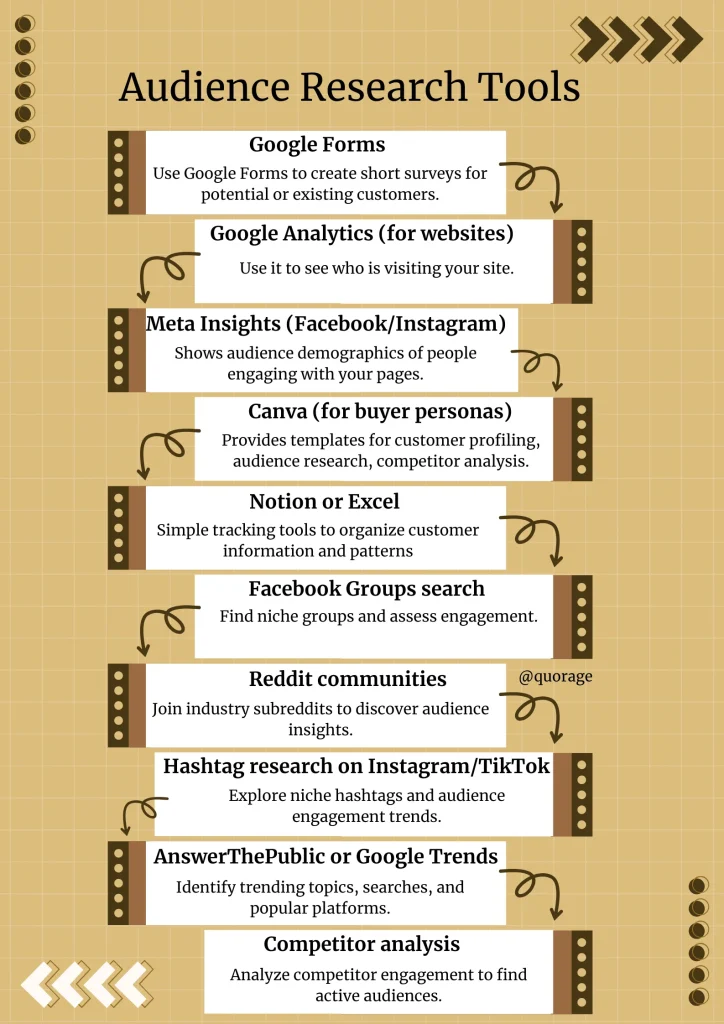
Some beginner-friendly tools you can use to do your audience research include:
- Google Forms: Use Google Forms to create short surveys for potential or existing customers. Ask about things like your audience’s needs, age, and preferences.
- Google Analytics (for websites): Use it to see who is visiting your site. You get insight such as user behaviour and demographics
- Meta Insights (Facebook/Instagram): Shows audience demographics of people engaging with your pages. Great for small businesses using social media marketing
- Canva (for buyer personas): Offers templates to visually build customer profiles, define your target audience, research your competitors, or review analytics
- Notion or Excel: Simple tracking tools to organize customer information and patterns
- Facebook Groups search: Look up niche-related groups and check engagement levels to see where your audience is actively participating
- Reddit communities: Join subreddits in your industry to observe real conversations, questions, and pain points your audience shares
- Hashtag research on Instagram/TikTok: Explore niche hashtags to identify where your audience engages most through likes, comments, and trending content
- AnswerThePublic or Google Trends: Use these tools to discover what your audience is searching for and which topics/platforms are gaining interest
- Competitor analysis: Study where your competitors post and see where they get the most engagement to pinpoint where your shared audience is already active.
- Social listening tools like Mention or Brandwatch. These are apps that track online conversations across social media, blogs, forums, and news sites to help you know what people are saying about your brand or industry in real time. They allow you to identify trends, monitor audience sentiment, and discover what your target audience cares about beyond your own content.
Over to you!
One of the biggest mistakes businesses make in online marketing is jumping in blindly and posting content without a clear understanding of who they’re trying to reach. Success doesn’t come from guessing; it comes from research. When you take the time to understand your audience first, every post, campaign, and strategy becomes intentional. That way, you save time, avoid wasted effort, and actually connect with the right customers.
Now you know where to start when finding your people online. Good luck as you begin your journey. Stay consistent and intentional as you build real connections with your audience.
FAQs
How do I know if a Facebook group is active?
To find out whether a Facebook group is active, check for recent posts in the last 72 hours. Also, don’t just check for likes; check for comments, questions, replies and conversation. If a group is large but quiet, it may not be useful.
Should I focus on one platform or many?
You should focus on one or two platforms that you think your audience spends most of their time on. Once you understand what works, you can expand. However, create accounts on all major social media platforms and repurpose content from the two platforms you are focusing on for consistency.
How long does it take to narrow down where my audience is online?
How long it takes to narrow down where your audience is online is not predictable. You should stay consistent for a few weeks and observe where engagement is strongest.
